On the beam.


 "Na na na na na. . .
 You can talk to me for five minutes and know that I love Nancy, Star Wars and Superman. On the other hand, you could talk to my parents for two days and walk away with just two insights into their lives: my dad is not happy about our public education system, and my mother is the funniest person on the planet.


I get the complaints about these reissues of the original trilogy, I do... and I understand that there's no such thing as too much money for George Lucas, honest... but are we Star Wars geeks so accustomed to complaining that we're just sucking the last dregs of joy from the franchise or what? And why do any of us complain about these reissues? It's not as though there's a chance we'd actually not buy one.
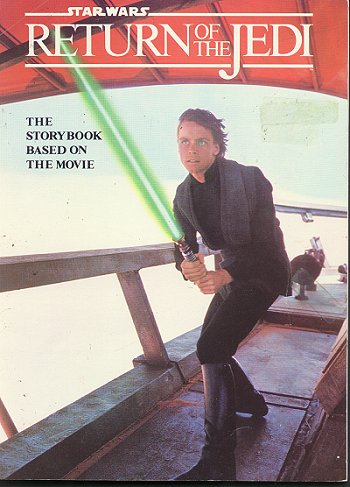
Look: those are the covers for the Star Wars reissues, coming this September, and I think they look rad. And come on, Han'll shoot first, Luke won't scream when he throws himself down the Bespin airshaft, and Anakin's apparition will once again be some benign middle-aged college professor.
So you sayers of nay? Drink a tall glass of shut the fuck up and get in touch with that kid who fell in love not just with all things sooty and shiny in a galaxy far, far away that Spring day in '77, but with the movies, alright? It's because of these films you even give a shit about aspect ratios and interpositives, and believe you me the original editions will never, ever measure up to your memories of them, so take 'em smaller and tinnier, and remember how even that was the best thing you'd seen since Steve Austin fought Bigfoot.

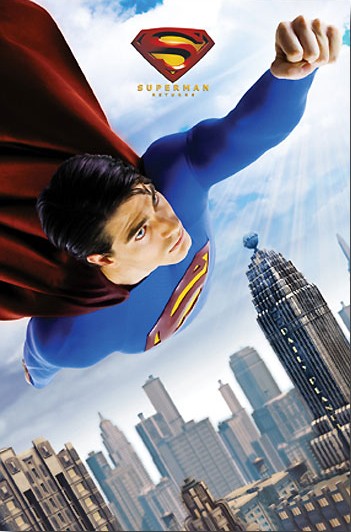
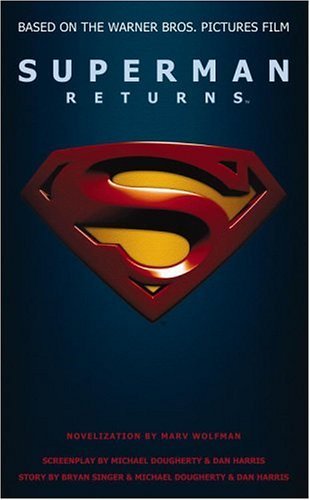
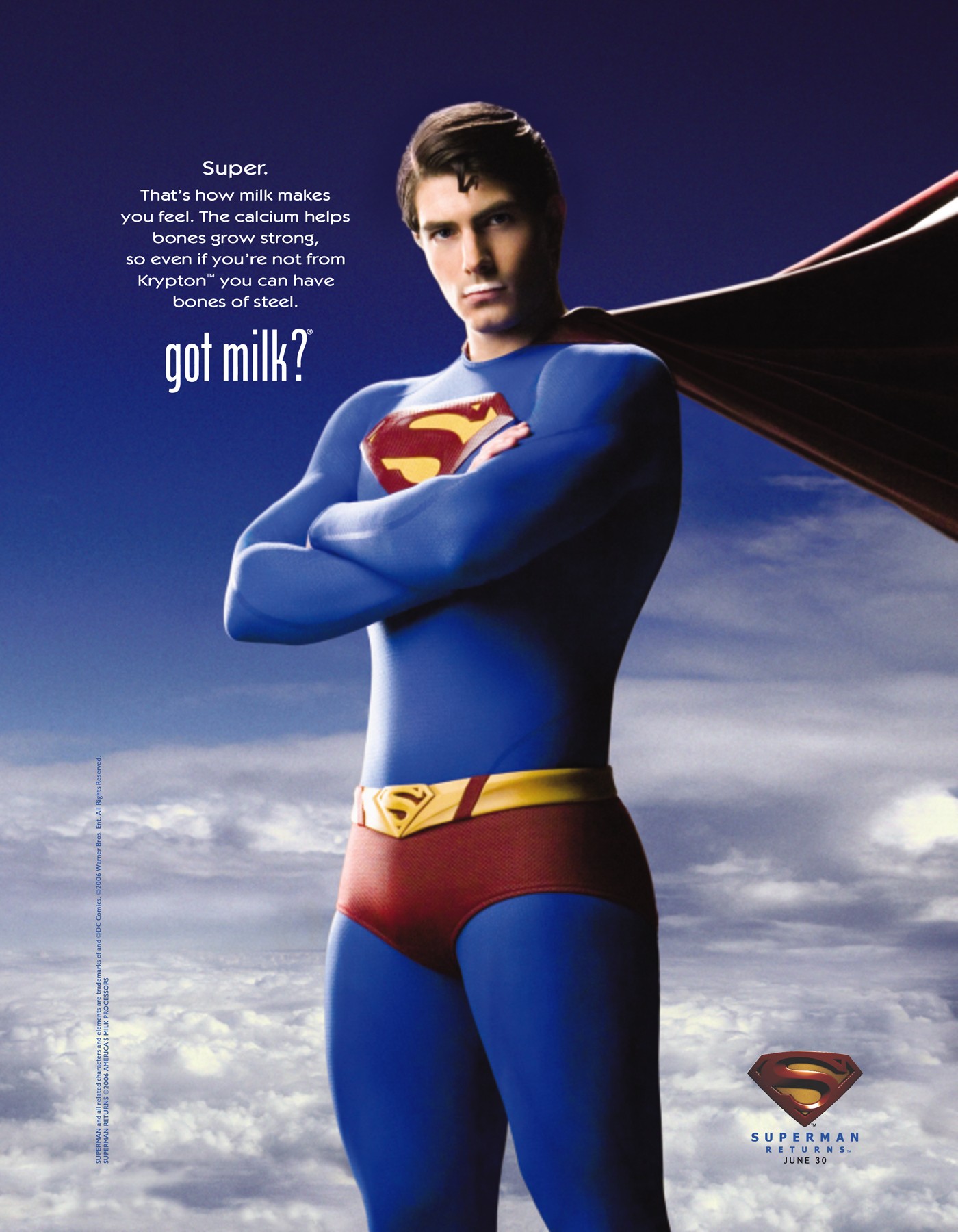 What, you thought the Superman posts would be slowing down? You thought maybe I'd get distracted by, oh I don't know... life and forget that Superman Returns opens in just over a month? You're stupid.
 I've been thinking a lot about my days in college radio recently.
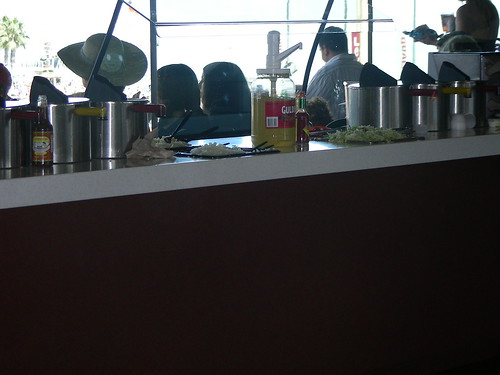 Nancy's gauntlet: condiment cart after condiment cart.
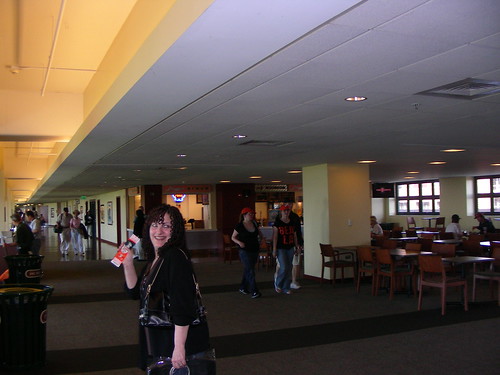 Nancy bravely running her gauntlet on the super-exclusive club level. She's smiling at Huey Lewis!
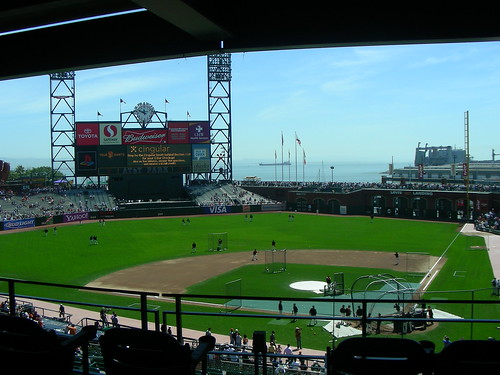 The field, from club level.
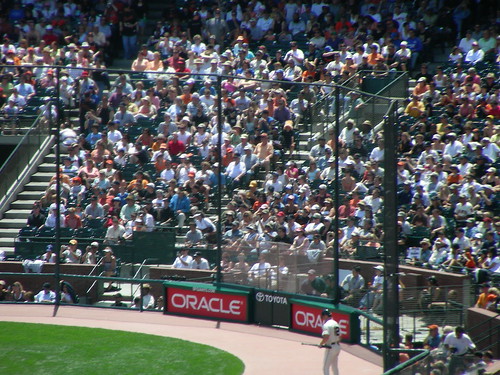 Our seats are 6 rows back from the Oracle banners. We're not in them; don't bother looking.
 The view from our seats. That's Barry Bonds, not hitting a ball.
 I'm not sure if this counts as celebrity gossip since it's fake and one of the people involved is a fictional character, but Brooke Burke and the Burger King dude have split up. If a former model and giant-headed hamburger spokesman can't make it in this crazy world of ours then what hope do the rest of us have?

 Editing & Proofreading Strategies:
 Once a rough draft is finished, you should try to set it aside for at least a day and come back to the paper with a fresh mind and thus more easily catch the errors in it. You’ll bring a fresh mind to the process of polishing a paper and be ready to try some of the following strategies.
If we read the paper aloud slowly, we have two senses--seeing AND hearing--working for us. Thus, what one sense misses, the other may pick up.
Write down your thesis on a piece of paper if it is not directly stated in your essay. Does it accurately state your main idea? Is it in fact supported by the paper? Does it need to be changed in any way? On that piece of paper, list the main idea of each paragraph under the thesis statement. Is each paragraph relevant to the thesis? Are the paragraphs in a logical sequence or order?
No matter how familiar others may be with the material, they cannot "get inside" your head and understand your approach to it unless you express yourself clearly. Therefore, it is useful to read the paper through once as you keep in mind whether or not the student or teacher or friend who will be reading it will understand what you are saying. That is, have you said exactly what you wanted to say?
Are there sufficient details? Is the logic valid?
Are the major points connected? Are the relationships between them expressed clearly? Do they all relate to the thesis?
Remember that others are reading your paper and that even the choice of one word can affect their response to it. Try to anticipate their response, and choose your words accordingly.
Original: The media's exploitation of the Watergate scandal showed how biased it was already.Revision: The media's coverage of the Watergate scandal suggests that perhaps those in the media had already determined Nixon’s guilt.
In addition to being more specific, the revision does not force the reader to defend the media. In the first example, though, the statement is so exaggerated that even the reader who is neutral on the issue may feel it necessary to defend the media. Thus, the writer of the original has made his job of persuading the reader that much harder.
No matter how many times you read through a "finished" paper, you're likely to miss many of your most frequent errors. The following guide will help you proofread more effectively
• Begin by taking a break. Allow yourself some time between writing and proofing. Even a five-minute break is productive because it will help get some distance from what you have written. The goal is to return with a fresh eye and mind.
• Try to s-l-o-w d-o-w-n as you read through a paper. That will help you catch mistakes that you might otherwise overlook. As you use these strategies, remember to work slowly. If you read at a normal speed, you won't give your eyes sufficient time to spot errors:
• Reading aloud. Reading a paper aloud encourages you to read every little word.
• Reading with a "cover." Sliding a blank sheet of paper down the page as you read encourages you to make a detailed, line-by-line review of the paper.
You won't be able to check for everything (and you don't have to), so you should find out what your typical problem areas are and look for each type of error individually. Here's how:
1. Find out what errors you typically make. Review instructors' comments about your writing and/or review your paper(s) with a Writing Lab tutor.
2. Learn how to fix those errors. Talk with your instructor and/or with a Writing Lab tutor. The instructor and the tutor can help you understand why you make the errors you do so that you can learn to avoid them.
3. Use specific strategies. Use these strategies to find and correct your particular errors in usage and sentence structure, and spelling and punctuation.
Try substituting concrete or personal subjects with active verbs.
Original: More attractiveness is sometimes given an act when it is made illegal.Revision: When an act becomes illegal, some people find it more attractive.
Original: They are desirous of ...Revision: They want ...
Since verbs tend to carry the meaning of your sentences, use the most precise and active ones possible. Thus, avoid constructions using the various forms of the verb "to be."
Original: Inflation is a threat to our economy.Revision: Inflation threatens our economy.
Remember the need for strong verbs.
Original: There were several reasons for the United States' entrance into the war.Revision: The United States entered the war for several reasons.
Because colloquialisms tend to be used so often, they also are not very precise in meaning. A hassle, for example, can be an annoyance, an argument, or a physical fight.
Original: Her behavior flipped me out.Revision: Her behavior first stunned, then delighted me.
Be sure that no parts of the paper are "short and choppy"; be sure that the rhythm of your paper is not interrupted, except for a good reason, like emphasis. A good way of smoothing out such a problem is to try combining sentences, and in so doing showing the relationship between them.
Original: The best show in terms of creating a tense atmosphere is "Jeopardy." This is probably the most famous of all games shows. It is my favorite show.Revision: The best show in terms of creating a tense atmosphere is "Jeopardy," which is also probably the most famous of all game shows and my favorite.
For subject/verb agreement:
1. Find the main verb in each sentence.2. Match the verb to its subject.
3. Make sure that the subject and verb agree in number.
For pronoun reference/agreement:
and 1. Skim your paper, stopping at each pronoun. Look especially at it, this, they, their,them.2. Search for the noun that the pronoun replaces. If you can't find any noun, insert one beforehand or change the pronoun to a noun. If you can find a noun, be sure it agrees in number and person with your pronoun.
See the OWL handout on pronouns.
For parallel structure:
1. Skim your paper, stopping at key words that signal parallel structures. Look especially for the following: and, or, not only...but also, either... or, neither...nor, both...and.2. Make sure that the items connected by these words (adjectives, nouns, phrases, etc.) are in the same grammatical form.
For more information, see the OWL handout on parallel structure.
For spelling:
1. Examine each word in the paper individually. Move from the end of each line back to the beginning. Pointing with a pencil helps you really see each word.2. If necessary, check a dictionary to see that each word is spelled correctly.
For more information, see the OWL handouts on spelling.
For compound sentence commas:
1. Skim for conjunctions: and, but, for, or, nor, so and yet.2. See whether there is a complete sentence on each side of the conjunction. If so, place a comma before the conjunction.
For more information, see the OWL handout compound sentence commas.
For introductory commas:
1. Skim your paper, looking only at the first two or three words of each sentence.2. Stop if one of these words is a dependent marker, a transition word, a participle, or a preposition.
3. Listen for a possible break point before the main clause.
4. Place a comma at the end of the introductory phrase or clause (which is before the independent clause).
For more information, see the OWL handout on commas after introductions.
For comma splices:
1. Skim the paper, stopping at every comma.2. See whether there is a complete sentence on each side of the comma. If so, add a coordinating conjunction after the comma or replace the comma with a semicolon.
For more information, see the OWL handout on commas.
For fragments:
1. Look at each sentence to see whether it contains an independent clause.2. Pay special attention to sentences that begin with dependent marker words (such as "because") or phrases such as "for example" or "such as."
3. See if the sentence might be just a piece of the previous sentence that mistakenly got separated by a period.
For more information, see the OWL handout on sentence fragments.
For run-on sentences:
1. Review each sentence to see whether it contains more than one independent clause. Start with the last sentence of your paper, and work your way back to the beginning, sentence by sentence.2. Break the sentence into two sentences if necessary.
See the OWL handout on comma splices.
For left-out words:
1. Read the paper aloud, pointing to every word as you read. Don't let your eye move ahead until you spot each word.2. Also, make sure that you haven't doubled any words.
 You need to understand this: when I first sat down at the Hesparian theater in 1977? It was just "STAR WARS." It wasn't Episode IV. It wasn't A New Hope. It was Star Wars, and it was the coolest thing I'd ever seen. You think I'd forget that?
 It's no secret that Superman is my favorite superhero. It's no wonder, and it's not just because he is, quantifiably, the greatest superhero in the long, storied history of superheroes. I won't go into it now... but know this:
Kids piled high, our moms and dads shook hands
in a party of Polaroid friends
rented a pool and hired a band
Maybe they knew more then we knew
cause they danced and drank
while we jumped off the deep end

Oh I've got you to thank for this

Christmas came around
yeah and everything was going to crap
and our moms and dads not a clue to be had
Yeah we put on a pretty good act
and they seemed to all need to believe it
so we danced and smiled and paddled hard beneath it

Oh I've got you to that for this

You can't say you've never had a doubt
and smoked it down but really wanted out

By the time the buzz was wearing off
we were standing out on the sidewalk
with our tattoos that looked like rings
in the hot Nevada sun
and they won't fade

~Ben Folds, You To Thank
 "And as excited as I am to be here with the President, I am appalled to be surrounded by the liberal media that is destroying America, with the exception of FOX News. FOX News gives you both sides of every story: the President's side, and the Vice President's side.
~Steven -"Ballsalicious"- Colbert